
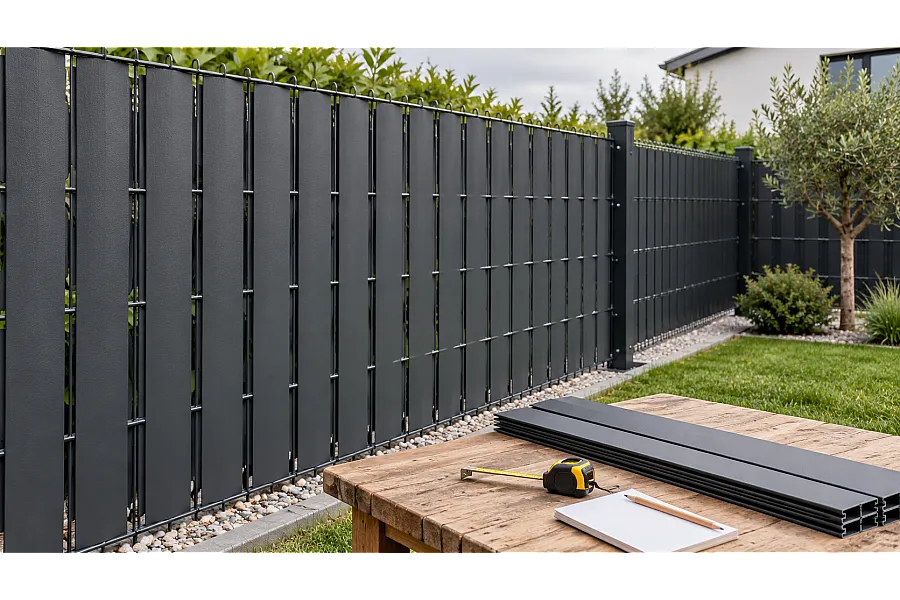
PVC fence covering is easiest to order when the calculation follows the real fence layout, not a single overall boundary length. Straight panel runs, gates, corners and unfinished end sections should be recorded separately before deciding the required quantity.
Make a simple run-by-run sketch
Walk the fence and number each uninterrupted panel section. Record its actual length, height and whether it contains a gate, corner, height change or end panel. This avoids ordering by a rough perimeter measurement and discovering later that usable panel area differs from the total boundary.
Separate openings and special sections
| Section | What to note |
|---|---|
| Straight run | Measured panel length and matching strip direction. |
| Gate | Whether the leaf will be covered and clearance needed around hardware. |
| Corner | Finish line, overlap and appearance from both approaches. |
| End section | Any cut or finish detail needed at the last panel. |
Use a small allowance deliberately
Allow for cutting, alignment corrections and a future replacement piece, but do not treat a vague excess as a substitute for measuring. The exact allowance depends on the panel layout, model and number of transitions. Keep each section on the same worksheet so changes can be reviewed before purchase.
Before ordering
- Confirm the installed panel dimensions rather than catalogue assumptions.
- Photograph corners, gates and end panels.
- Check the intended strip model against the panel geometry.
- Keep a labelled note of every measured run.
Review available fence-covering solutions after the site measurement is complete. A clear layout sketch is more useful than a rushed total metre figure.