
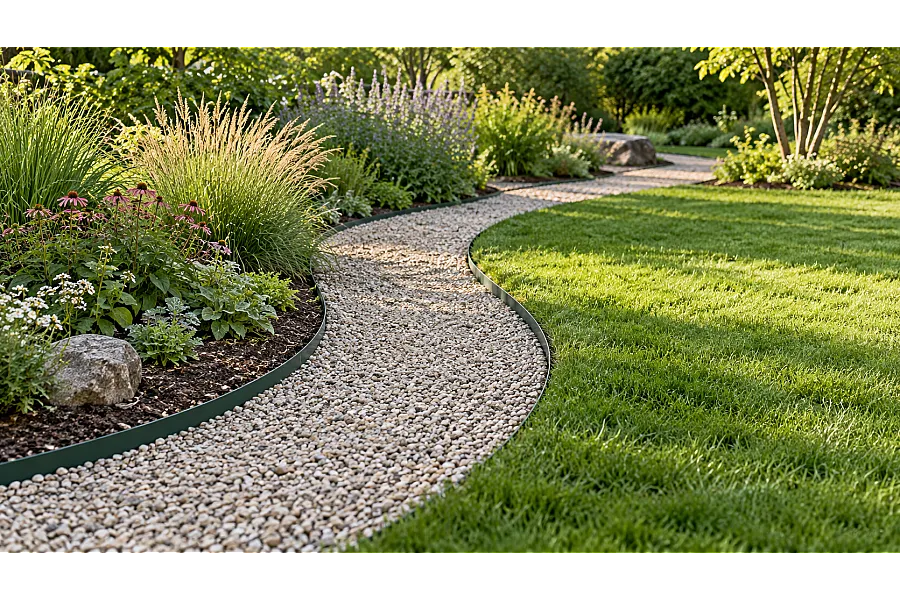
Planning note: Lawn edging is not just a thin line separating the lawn and the soil. It collectively influences the rhythm of the path, the border of the plant bed, and how legible the maintenance area will appear.
The sense of order in a garden often comes not from large elements, but from the correct arrangement of small borders. When the transitions between the lawn and the walkway, or between stone paving and a plant bed or vegetable patch, remain ambiguous, watering, mowing, and cleaning become much more troublesome. Lawn edging is one of the practical solutions used to clarify these transitions.
For a good result, instead of selecting the product solely by the meter, it is necessary to consider the turns in the garden, the path width, existing plants, and water flow together. A straight line and a curved plant bed do not require the same cutting and placement approach.
First, determine the usage line of the garden Planning begins not with placing a product, but with marking where the walk will pass and where the plant area will begin. When the line extending from the entrance gate to the seating area, the service passage, watering points, and daily used areas are shown on a simple sketch, it becomes clear much earlier where the edge of the path will remain straight and where it will curve.
The border created to separate the flower bed from the lawn must also be compatible with the reach of the lawnmower. Very narrow, sharp, or hard-to-reach turns may look nice in the short term, but they can create trouble in daily maintenance.
Path width and turning radius should be considered together The width of a garden path is not merely the sum of two rows of stones. The growth margin of the plants next to it, furniture moving, watering hoses, and whether two people can pass side by side must also be taken into account. Before laying the lawn edging, it is useful to check the actual usable width at every point of the path.
If a curved line is planned, natural transitions look more balanced than hard corners. Taking one of the existing elements as a reference, such as a surrounding wall, terrace, stepping stone, or raised bed, reduces the feeling of it being a later addition to the garden.
Practical tip: Before making the placement permanent, set up the border with a string, hose, or temporary marker; check the comfort of the turns by walking the path a few times.
Do not ignore the ground and water flow Low-elevation areas in the garden, points where water pools after rain, or roots protruding from the ground affect the behavior of the boundary line. No matter how neatly the edging is placed, if the ground sinks or water is directed into the bed, the appearance can quickly deteriorate. Therefore, it is necessary to visually check the slope and drainage before placement.
If stone, gravel, lawn, and soil do not meet at the same level, determining small elevation differences for transitions from the start yields a cleaner result. The goal is not to cut off rainwater entirely, but to prevent the natural flow in the garden from disrupting the usage areas.
The right boundary for the plant bed also reduces maintenance time Mulch, soil, and decorative stones remain more controlled in beds separated by lawn edging. In addition, an allowance must be made for root development, the outward spread of plants, and seasonal pruning. A very narrow bed looks tidy on the first day; however, as the plants grow, they can create pressure on the path or lawn area.
If vegetable growing or distinct planting areas are planned, it is possible to evaluate lawn edging in the same arrangement with raised garden bed solutions. Thus, both the planting zone and the transition line around it are defined separately.
Establish harmony with materials and garden elements The color and line of the edging create a more cohesive look when considered together with the tones of stone paving, wooden details, planters, pergolas, or fences. Instead of using a different material in every corner, proceeding with two or three basic tones looks calmer and more orderly in most gardens.
The path edge, plant bed, and lawn boundary are not independent pieces from one another, but parts of the landscape that meet in the same drawing. Establishing this relationship from the start also makes later additions easier.
Pre-application checklist
Actual width of the walking and service line
Straight lines, corners, and soft turns
Points where water might pool in the rain
Existing plant roots and growth margin
Access area for lawn mowing, watering, and maintenance
Elevation relationship of stone, soil, gravel, and other surfaces
Garden boundaries also provide ease of use Lawn edging is not merely a decorative finishing detail. It is a planning element that determines how the path, the bed, and the lawn area complement each other. When measurements, water flow, and daily use are considered together, the garden looks more organized, and maintenance